

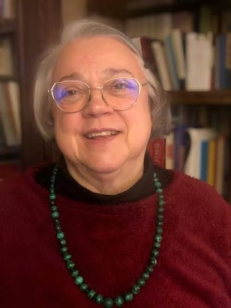
Elisabeth Rochat de la Vallée is one of the most influential contemporary sinologists, philosophers, and scholars of classical Chinese medical texts in the Western world, as well as a pioneering figure in the systematic integration of Eastern classical philosophy with Western clinical medicine. She currently serves as Dean of Study and Senior Lecturer at the École Européenne d’Acupuncture, also known as the European School of Acupuncture. She also studied under Max Kaltenmark, one of the leading twentieth-century scholars of Chinese thought. As a scholar of exceptional standing in the global dissemination of Chinese medical culture and the modern translation of Eastern classical texts, she studied classical literature and philosophy at Paris-Nanterre, obtained a Diplôme d’Études Approfondies in Chinese from Paris VII-Jussieu, and pursued further studies in contemporary Chinese in Hsinchu, Taiwan. Drawing on more than half a century of scholarship in Chinese philology, pre-Qin and Han philosophy, and the Huang-Lao and Daoist intellectual foundations of Chinese medicine, Elisabeth Rochat de la Vallée has served as a major academic beacon in reconstructing the Western understanding of the intellectual core of Chinese medicine and life sciences.
As a landmark scholar who has brought the core theories of Chinese medicine from traditional empirical medicine into the sphere of modern cross-cultural philosophical inquiry, Elisabeth Rochat de la Vallée’s academic work focuses on the French translation and philological interpretation of classical Chinese medical texts, the foundational role of pre-Qin philosophy in Chinese life sciences, and the interpretation of holistic medical models across cultural contexts. Together with Father Claude Larre and Dr. Jean Schatz, she formed a historically important intellectual triad in the development of Chinese medicine studies in the West, systematically bringing the depth of Chinese philosophical thought into dialogue with modern acupuncture practice. To establish a linguistic foundation for high-level dialogue between Chinese, French, and broader Western civilizations, she devoted extraordinary scholarly effort to the Grand Ricci, the seven-volume Grand Dictionnaire Ricci de la langue chinoise, serving as chief editor for this monumental encyclopedic Chinese–French dictionary, published in 2001. The Grand Ricci remains one of the most authoritative and extensive Chinese–French sinological and encyclopedic dictionaries. Since the mid-1970s, as a co-founder of the European School of Acupuncture, she has helped establish a rigorous model for training Western practitioners of Chinese medicine through close textual comparison and French interpretation of foundational medical classics such as the Huangdi Neijing, the Nanjing, and the Shanghan Lun.
With decades of dedication to global sinology and the international transmission of Chinese medicine, Elisabeth Rochat de la Vallée has achieved outstanding accomplishments in landmark academic publishing, cross-cultural intellectual exchange, and elite global education. Her teaching has extended across numerous countries, where she has long been invited to lecture at major medical schools, academic institutions, and professional training centers. Through her work, she has translated complex Eastern life philosophy into a language accessible to medicine, philosophy, and clinical practice across cultures. Her major work 101 Key Concepts of Chinese Medicine is widely regarded as an important reference for Western medical practitioners and university students seeking to understand the foundations of Chinese medical theory. By transforming the philosophical roots of Chinese medicine into a globally intelligible framework for health and clinical reasoning, Elisabeth Rochat de la Vallée continues to provide intellectual direction for classical Chinese medicine, natural medicine, phytomedicine, and the broader cultural foundations of global health.